What Are Kitchen Tools Called A Complete Guide Inside
What are kitchen tools called? Kitchen tools go by many names, including kitchen utensils, cooking tools, and culinary equipment. This guide breaks down every category, from cutting tools to mixing tools, so you can confidently navigate any kitchen.
Key Takeaways
- Kitchen tools have multiple names: They are commonly called kitchen utensils, cooking tools, culinary equipment, or simply kitchenware.
- Tools fall into clear categories: Cutting, mixing, measuring, heating, prep, and serving tools each serve distinct purposes.
- Every home cook needs basics: A chef’s knife, cutting board, mixing bowls, measuring cups, and spatula cover most cooking needs.
- Specialty tools exist for specific tasks: Tools like mandolines, thermometers, and microplanes solve unique cooking challenges.
- Material matters: Stainless steel, wood, silicone, and cast iron each offer different benefits for durability and safety.
- Proper care extends tool life: Hand washing, proper storage, and regular sharpening keep your tools performing their best.
📑 Table of Contents
- What Are Kitchen Tools Called? A Complete Guide Inside
- Understanding Kitchen Tool Names and Terminology
- Categories of Kitchen Tools Explained
- Essential Kitchen Tools Every Home Cook Should Own
- Specialty Kitchen Tools and Their Names
- How to Choose the Right Kitchen Tools
- Maintaining Your Kitchen Tools
- Conclusion
What Are Kitchen Tools Called? A Complete Guide Inside
Walking into any kitchen, you will see dozens of gadgets, devices, and implements sitting on counters and hanging on walls. But what are kitchen tools called exactly? The answer is simpler than you might think. Most people use terms like kitchen utensils, cooking tools, culinary equipment, or kitchenware to describe them all.
These names sometimes overlap. The word “utensil” often refers to smaller handheld items like spoons and spatulas. “Equipment” covers larger pieces like mixers and ovens. Understanding these differences helps you shop smarter, cook more efficiently, and talk about your kitchen gear with confidence.
Whether you are a beginner cook or a seasoned home chef, knowing the proper names and categories of every tool in your kitchen makes a real difference. This guide covers everything you need to know.
Understanding Kitchen Tool Names and Terminology
The world of cooking gear has its own language. Different names pop up depending on who you talk to and where you live. Let us break down the most common terms used to describe kitchen tools and utensils.
Kitchen Utensils vs. Kitchen Tools vs. Kitchenware
These three terms get used almost interchangeably, but they carry subtle differences.
- Kitchen utensils usually refer to smaller, handheld items. Think wooden spoons, whisks, peelers, and tongs. These are your workhorses for day-to-day cooking tasks.
- Kitchen tools is a broader term. It covers both small utensils and larger devices like blenders, food processors, and mixers. If it helps you prepare food, it qualifies as a kitchen tool.
- Kitchenware is a catch-all phrase used in retail and everyday speech. It includes everything from pots and pans to cutting boards and storage containers.
Another term you will hear is cookware. This specifically refers to items that come into direct contact with heat, such as skillets, saucepans, and Dutch ovens. Cookware is a subset of kitchen tools focused on the heating and cooking process.
Culinary Equipment and Cooking Gear
Culinary equipment leans toward the professional side. Restaurants and commercial kitchens use this term for their larger apparatus, like industrial ovens, refrigeration units, and prep tables. Home cooks might also use this term for high-end appliances like stand mixers or wine coolers.
Cooking gear feels more casual and personal. It is the term many home cooks use to describe their personal collection of favorite items. Your cooking gear says a lot about your style and preferences in the kitchen.
Categories of Kitchen Tools Explained
Organizing your kitchen tools into categories makes cooking feel less chaotic. Every essential kitchen tool fits into one of these main groups. Let us walk through each category and highlight the key items you will find inside.
Cutting and Chopping Tools
These are probably the most important tools in any kitchen. Cutting tools handle all the slicing, dicing, mincing, and chopping that food prep demands.
- Chef’s knife: The king of the kitchen. This versatile blade handles about 90% of all cutting tasks. A good chef’s knife is a must-have for every home cook.
- Paring knife: Smaller and more precise. Use it for peeling fruits, trimming vegetables, and detailed work that a chef’s knife is too bulky for.
- Serrated bread knife: Designed with teeth to slice through crusty bread without crushing it. It also works well for delicate items like tomatoes.
- Cutting boards: Wood, bamboo, or plastic boards that protect your counters and your knife edges. Many cooks keep at least two: one for raw meat and one for produce.
- Kitchen shears: Often overlooked but incredibly useful for cutting herbs, opening packaging, or spatchcocking poultry.
Other items in this category include mandolines for thin, uniform slices, mezzalunas for rocking cuts, and food processors for bulk chopping.
Mixing and Blending Tools
Baking and cooking often require combining ingredients. Mixing tools make this process easier and more consistent.
- Mixing bowls: Available in various sizes, these are fundamental for tossing salads, whisking batters, and marinating meats. Stainless steel and glass bowls are the most popular choices.
- Whisk: A simple wire tool that aerates and blends ingredients quickly. Balloon whisks work best for general mixing, while flat whisks suit sauces.
- Electric mixer: Handheld or stand models save enormous time when beating eggs, cream, or dough. This is one of the most common kitchen gadget names in home kitchens.
- Blender: Used for smoothies, soups, and purees. Immersion blenders let you blend directly in the pot, which reduces cleanup.
- Spatula and scraper: Rubber or silicone spatulas scrape every bit of batter from bowls. They also flip foods gently during cooking.
Measuring Tools
Accurate measurements separate good cooking from great cooking. Measuring tools ensure precision every time.
- Measuring cups: Dry and liquid versions exist. Dry cups measure flour and sugar by leveling off the top. Liquid cups have clear markings and a pour spout.
- Measuring spoons: Small but mighty. These handle spices, baking powder, and extracts with accuracy. A full set typically includes tablespoons, teaspoons, and fractions of both.
- Kitchen scale: Serious bakers rely on these for weight-based measurements. Weight is far more accurate than volume for dry ingredients like flour.
- Thermometer: Instant-read and probe thermometers check internal temperatures of meats, candy mixtures, and bread dough. Food safety depends on knowing exact temperatures.
Heating and Cooking Tools
These tools bring heat to your food. They include both stovetop implements and small appliances.
- Pots and pans: Skillets, saucepans, Dutch ovens, and stockpots form the backbone of any kitchen. Cast iron, stainless steel, and nonstick coatings each offer unique advantages.
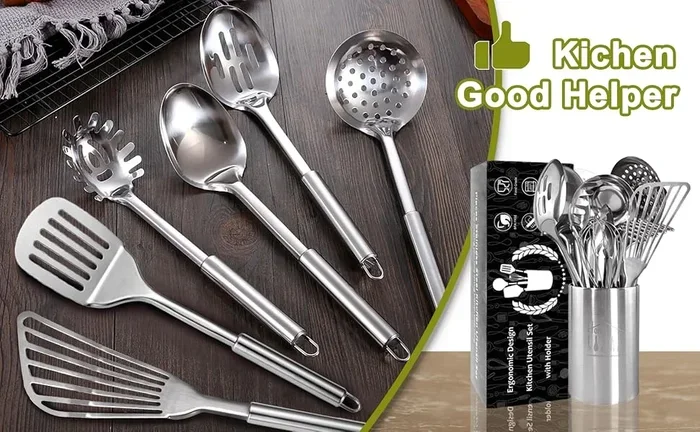
- Cooking utensils: Wooden spoons, metal tongs, slotted turners, and ladles help you stir, flip, serve, and taste food while it cooks.
- Oven tools: Oven mitts, baking sheets, cooling racks, and loaf pans all support oven cooking. Heat-resistant tools are critical for safe handling.
- Small appliances: Toasters, air fryers, slow cookers, and instant pots each add convenience. These are popular kitchen equipment names that save time and effort.
Quick Tip: Invest in one high-quality chef’s knife and a sturdy cutting board before buying anything else. These two items alone will transform your cooking experience.
Preparation and Serving Tools
Before food hits the heat, it needs prep work. After cooking, it needs to be presented well. This category covers both ends of the process.
- Peeler: Y-shaped or swivel peelers strip vegetable and fruit skins quickly. A good peeler saves minutes of tedious knife work.
- Grater and microplane: These shred cheese, zest citrus, and grate ginger. A microplane produces finer results than a standard box grater.
- Tongs: Spring-loaded tongs grip, lift, and turn foods safely. They are arguably the most versatile tool in the kitchen.
- Serving spoons and ladles: Large spoons and ladles portion soups, stews, rice, and sauces onto plates.
- Colander and strainer: Drain pasta, wash produce, and rinse grains with these perforated tools.
Essential Kitchen Tools Every Home Cook Should Own
You do not need a fully stocked professional kitchen to cook great meals. Most home cooks get by beautifully with a focused set of basic kitchen tools. Here is a practical list of must-haves.
The Core Kit
Start with these fundamentals. They cover the vast majority of recipes you will encounter:
- Chef’s knife — your primary cutting tool for everything
- Cutting board — protects counters and knives
- Wooden spoon — gentle stirring for sauces and soups
- Metal tongs — gripping and turning hot foods
- Mixing bowls — set of three sizes for general use
- Measuring cups and spoons — accuracy for baking and cooking
- Spatula — flipping and scraping with ease
- Skillet and saucepan — covers most stovetop cooking
- Colander — draining pasta and washing vegetables
- Oven mitts — keeping your hands safe
This core kit handles roughly 80 to 90 percent of home cooking tasks. Once you feel comfortable with these, you can slowly add specialty items based on your interests and cooking style.
Building on the Basics
After your core kit is in place, consider adding these items to expand your capabilities:
- A paring knife for detailed work
- A kitchen scale for precise baking
- A whisk for baking and beating eggs
- A blender or immersion blender for soups and smoothies
- A mandoline for beautiful vegetable slices
- A kitchen thermometer for perfectly cooked meats
Expert Insight: Professional chefs often say that fewer, higher-quality tools outperform many cheap ones. A single well-made chef’s knife will serve you for decades if you care for it properly. Focus on quality over quantity when building your kitchen collection.
Specialty Kitchen Tools and Their Names
Beyond the basics, many specialty kitchen tools exist for specific tasks. You may not need them every day, but they can be game-changers when the right recipe comes along.
Baking-Specific Tools
Bakers rely on tools that most savory cooks rarely touch. Rolling pins, pastry brushes, dough cutters, and cake pans are just a few examples. Silicone baking mats replace parchment paper and provide a nonstick surface. Bench scrapers help portion and shape dough quickly.
Gadgets for Specific Tasks
Some tools solve very focused problems:
- Garlic press: Crushes garlic cloves into fine pieces instantly. If you cook Italian food often, this tool earns its spot in the drawer.
- Citrus reamer: Extracts juice from lemons and limes better than squeezing by hand.
- Apple corer: Removes the core in one clean motion. It also works for pears and similar fruits.
- Egg slicer: Creates uniform egg rounds for salads and sandwiches. Simple and surprisingly satisfying to use.
- Can opener: A classic tool that every kitchen needs. Manual and electric versions both get the job done.
Modern Kitchen Innovations
Technology has introduced a new generation of kitchen tools. Smart thermometers connect to your phone. Sous vide circulators cook food in precisely controlled water baths. Silicone molds create perfectly shaped ice cubes, portioned meals, and decorative desserts. These items expand what home cooks can achieve without professional training.
How to Choose the Right Kitchen Tools
With so many options available, picking the right cooking tools and equipment can feel overwhelming. A few simple guidelines help you make confident choices.
Consider Material
The material affects durability, safety, and performance. Here is a quick comparison of common kitchen tool materials:
| Material | Best For | Pros | Cons |
|---|---|---|---|
| Stainless Steel | Pots, pans, knives | Durable, non-reactive, easy to clean | Can be expensive, poor heat distribution alone |
| Cast Iron | Skillets, Dutch ovens | Excellent heat retention, lasts forever | Heavy, needs seasoning, rust-prone if stored damp |
| Silicone | Spatulas, bowls, molds | Flexible, nonstick, heat-resistant | Can stain, not ideal for heavy cutting tasks |
| Wood | Cutting boards, spoons | Gentle on knives, naturally antibacterial | Cannot go in dishwasher, needs oiling |
| Plastic | Measuring cups, containers | Lightweight, affordable, dishwasher-safe | Can warp, scratch, and leach chemicals when heated |
Think About Your Cooking Style
Your daily habits should drive your tool choices. If you bake weekly, prioritize high-quality mixing bowls, a kitchen scale, and precise measuring tools. If you grill often, invest in sturdy tongs, a meat thermometer, and a grill brush. Match your tools to what you actually cook.
Set a Budget
You do not need to spend a fortune. Many affordable tools perform just as well as premium brands for everyday tasks. Spend more on items you use daily, like knives and cutting boards. Save money on tools you use occasionally by choosing mid-range options.
Common Mistake: Many beginners buy huge sets of cookware and gadgets all at once. This leads to clutter and unused tools. Instead, start with the essentials and add items gradually as your skills and recipes grow.
Maintaining Your Kitchen Tools
Once you have built your collection, proper care keeps everything in top shape. Well-maintained tools perform better, last longer, and keep your food safe.
Cleaning Best Practices
- Hand wash wooden and cast iron items. Dish soap and water are fine for most items, but prolonged soaking damages wood. Dry everything immediately after washing.
- Use non-abrasive sponges on nonstick surfaces. Abrasive pads scratch coatings and reduce their effectiveness. Soft sponges or cloths work much better.
- Sharpen knives regularly. A dull knife is more dangerous than a sharp one because it slips easily. Use a whetstone or professional sharpening service every few months.
Storage Tips
How you store tools matters more than you think. Knives stored loosely in drawers get dull and dangerous. Use a knife block, magnetic strip, or blade guards. Pots and pans stacked without protection scratch each other. Place a cloth or paper towel between layers to prevent damage.
Quick Tip: Organize tools by category near your workspace. Keep cutting tools and prep items close together by your counter. Store heating tools like tongs and spatulas near the stove. This simple system speeds up every cooking session.
When to Replace Tools
No tool lasts forever. Watch for these signs that a replacement is due:
- Nonstick coatings are peeling or flaking
- Wooden items show deep cracks or persistent stains
- Knife handles are loose or broken
- Metal tools show significant rust or corrosion
- Plastic items have warped, discolored, or developed an odor
Replacing worn-out tools promptly keeps your cooking safe and efficient. Do not hold onto damaged items out of habit.
Conclusion
Now you know the answer to what are kitchen tools called and much more. From cutting tools to mixing tools, from basic essentials to specialty gadgets, every item in your kitchen has a name, a purpose, and a place. Understanding these categories empowers you to cook with confidence, shop wisely, and keep your kitchen organized.
Start with the essentials, learn how to use them well, and gradually expand your collection as your skills grow. Quality always beats quantity. Care for your tools properly, and they will reward you with years of reliable service. Your kitchen is your space — fill it with tools that make cooking joyful, not stressful.
Frequently Asked Questions
What is the difference between kitchen tools and kitchen utensils?
Kitchen tools is a broad term covering everything from small handheld items to large appliances. Kitchen utensils specifically refer to smaller handheld items like spoons, whisks, and peelers. In everyday conversation, most people use these terms interchangeably without any real confusion.
What are the 5 basic kitchen tools every cook needs?
Every cook needs a chef’s knife, a cutting board, a wooden spoon, a sturdy skillet, and a mixing bowl. These five items handle the majority of everyday cooking tasks and form the foundation of any functional kitchen.
What do you call the tools used for baking?
Baking tools are often called bakeware or baking utensils. Common examples include mixing bowls, measuring cups, whisks, rolling pins, pastry brushes, and cake pans. Silicone molds and dough cutters also fall into this category of specialized baking gear.
Are pots and pans considered kitchen tools?
Yes, pots and pans are kitchen tools. More specifically, they are classified as cookware because they come into direct contact with heat. They belong to the heating and cooking category of kitchen tools alongside utensils like tongs and spatulas.
How do I choose quality kitchen tools on a budget?
Focus on buying a few high-quality basics like a good chef’s knife and sturdy cutting board. Choose affordable options for items you use less often. Stainless steel, cast iron, and solid wood tools tend to offer the best long-term value for the price.
What kitchen tools should beginners avoid buying?
Beginners should avoid buying large gadget sets, single-use tools like avocado slicers or strawberry hullers, and expensive specialty items they have never used. Instead, start with versatile basics that serve multiple purposes and add more as your cooking skills develop.