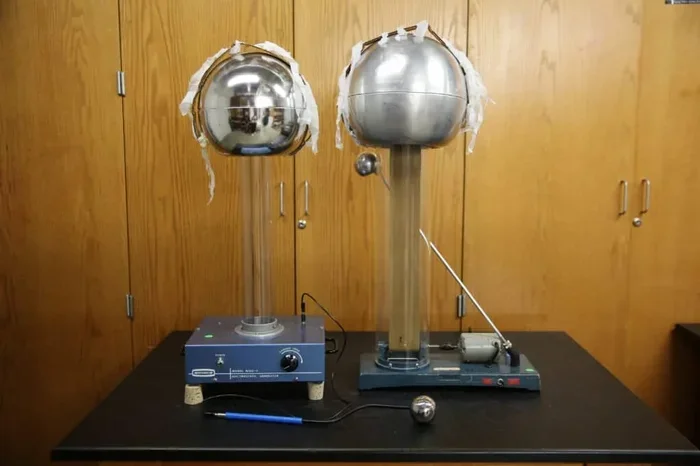
Van Der Graaf Generator How It Works And Why It Matters
A Van Der Graaf generator is a fascinating electrostatic device that produces extremely high voltages using a simple moving belt mechanism. Invented by Robert Van de Graaff in 1929, this machine demonstrates the power of static electricity in a way that captivates audiences of all ages. Whether you are a science enthusiast, a student, or a curious mind, understanding how this generator works opens up a world of electrostatic principles and real-world applications.
Have you ever walked across a carpet and touched a metal doorknob, only to feel a tiny zap? That is static electricity in action. Now imagine scaling that same principle up to produce millions of volts of electricity. That is exactly what a Van Der Graaf generator does. This remarkable machine has been fascinating scientists, students, and curious minds since the 1920s.
Despite its intimidating name and impressive voltage output, the Van Der Graaf generator is built on surprisingly simple principles. It uses a moving rubber belt, a metal sphere, and a few basic components to generate enormous amounts of static charge. In this article, we will break down exactly how it works, why it matters, and where you might encounter one in real life.
Key Takeaways
- Simple Design, Massive Output: A Van Der Graaf generator uses a moving belt and hollow metal sphere to generate voltages exceeding one million volts.
- Based on Electrostatic Principles: The device relies on charge separation and corona discharge to build up massive voltage potential.
- Used in Science and Medicine: From particle physics research to medical accelerators, this generator plays a surprising role in real-world applications.
- Great Educational Tool: Science museums and classrooms use it to demonstrate static electricity and electrical discharge in a safe, visual way.
- Different From Fuel Generators: Unlike conventional generators, the Van Der Graaf produces electricity through mechanical movement and electrostatic induction, not combustion.
- Safe to Observe: Despite the extreme voltages, the low current makes demonstrations safe for audiences.
- Easy to Build or Buy: Hobbyists can build smaller versions at home, or purchase classroom-grade models from science suppliers.
📑 Table of Contents
- What Is a Van Der Graaf Generator?
- How a Van Der Graaf Generator Works
- Why the Van Der Graaf Generator Matters
- Applications and Uses of the Van Der Graaf Generator
- Building vs Buying a Van Der Graaf Generator
- Common Mistakes and How to Avoid Them
- Expert Insights on the Van Der Graaf Generator
- Key Takeaways
- Conclusion
What Is a Van Der Graaf Generator?
A Van Der Graaf generator is a type of electrostatic generator that produces very high voltages at low currents. It was invented by American physicist Robert Van de Graaff in 1929 while he was a doctoral student at Oxford University. The device was originally designed to provide the high-energy particles needed for early nuclear physics research.
The basic structure of the generator is quite elegant. It consists of a large hollow metal sphere mounted on an insulated column. Inside, a rubber or fabric belt loops around two rollers. One roller sits at the base, and the other sits inside the sphere near the top. A motor drives the belt, and as it moves, it carries electric charge up to the inside of the metal sphere.
Over time, charge builds up on the outer surface of the sphere. Because the sphere is hollow, the charge distributes evenly across its exterior surface. This allows the generator to reach extremely high voltages, often exceeding one million volts in larger models. The result is a spectacular display of electrical discharge, complete with sparking and the famous “lightning bolt” effect that makes hair stand on end.
How Does It Compare to Other Generators?
If you are wondering about the different types of generators out there, you might ask, what kind of generator do I need for various applications? The answer depends entirely on your purpose. A Van Der Graaf generator is not meant to power your house or charge your devices. It is a specialized electrostatic generator designed for high-voltage demonstration and research.
Conventional generators, like those you might find at a hardware store, produce electricity through electromagnetic induction. They burn fuel or use external power sources to spin a rotor inside a magnetic field. A Van Der Graaf generator takes a completely different approach. It uses mechanical movement and charge separation to build voltage. This makes it fundamentally different from fuel-based or inverter generators, yet equally fascinating in its own right.
How a Van Der Graaf Generator Works
The operation of a Van Der Graaf generator relies on a few core principles of electrostatics. Let us walk through the process step by step so you can visualize exactly what happens inside the machine.
The Charging Roller and Belt
At the base of the generator sits the lower roller. This roller is typically made of a material like Teflon or rubber. Below it, a corona discharge electrode applies a small electrical charge to the belt as it passes over the roller. The belt, usually made of rubber or silicone, picks up this charge and begins to move.
As the motor turns the lower roller, the belt carries the positive charge upward toward the inside of the metal sphere. The upper roller, located near the top of the sphere, receives the charge from the belt and transfers it to a collection comb. From there, the charge travels to the outer surface of the hollow metal sphere.
Charge Accumulation on the Sphere
Here is where the magic happens. The hollow metal sphere acts as a charge reservoir. Each time the belt makes a revolution, it delivers more charge to the sphere’s surface. Because like charges repel each other, the charge spreads out evenly across the exterior of the sphere.
The voltage on the sphere continues to rise as long as the belt keeps moving. In a typical classroom model, you might see voltages of 100,000 to 500,000 volts. Larger demonstration models can exceed one million volts. However, the current remains extremely low, usually in the microamp range. This is why the discharge, while dramatic, is not lethal.
The Discharge Effect
When the voltage becomes high enough, the electric field at the surface of the sphere overcomes the insulating properties of the surrounding air. This causes a corona discharge or a visible spark. The air molecules ionize, creating a brief pathway for the charge to escape. The result is a bright spark, a cracking sound, and sometimes a visible glow.
If a person touches the sphere while standing on an insulated platform, the charge transfers to their body. Because human hair is conductive, each strand becomes charged with the same polarity. The strands repel each other, causing hair to stand straight up. This is the iconic Van Der Graaf effect that everyone remembers from science class.
Why the Van Der Graaf Generator Matters
You might wonder why a device that produces sparks and makes hair stand up matters in the real world. The truth is, the Van Der Graaf generator has played a significant role in science, medicine, and education for nearly a century.
Pioneering Nuclear Physics Research
When Robert Van de Graaff first built the device, his goal was to accelerate particles for nuclear research. The high voltage produced by the generator could be used to propel charged particles at targets, allowing scientists to study the structure of the atom. This was cutting-edge technology in the 1930s and helped lay the groundwork for modern particle physics.
At its peak, the MIT Van Der Graaff accelerator housed one of the most powerful particle accelerators in the world. Researchers used it to conduct experiments in nuclear physics long before larger and more powerful machines took over. The principles behind the Van Der Graaf generator directly influenced the development of particle accelerators used in facilities like CERN today.
Medical and Industrial Applications
Beyond the physics lab, the principles of the Van Der Graaf generator find use in several practical fields. In medicine, similar electrostatic principles are used in certain types of radiation therapy equipment. The ability to generate controlled high-voltage discharges plays a role in sterilization and ion beam applications.
Industrially, electrostatic generators are used in processes like powder coating and air filtration. Charged particles are attracted to surfaces, allowing for even coating of metals and other materials. While these applications use more modern designs, the foundational concepts trace back to the Van Der Graaf generator and its electrostatic principles.
A Powerful Educational Tool
Perhaps the most widespread impact of the Van Der Graaf generator is in education. Science museums around the world feature these devices as centerpiece demonstrations. Students get to see abstract concepts like static electricity, voltage, and electrical discharge come to life in a way that textbooks simply cannot match.
Watching a spark jump between two electrodes or feeling your hair stand on end creates a memorable learning experience. These moments spark curiosity and encourage young minds to explore the world of physics. In this way, the Van Der Graaf generator does more than produce sparks. It inspires the next generation of scientists and engineers.
Applications and Uses of the Van Der Graaf Generator
The Van Der Graaf generator serves a variety of roles depending on its size and power. Let us explore some of the most common applications you will find.
- Physics Demonstrations: Teachers use the generator to demonstrate electrostatic charge, voltage, and discharge. The visible sparks and hair-raising effects make complex concepts easy to understand.
- Particle Acceleration: In research settings, the generator provides the initial high voltage needed to accelerate ions and subatomic particles for collision experiments.
- X-Ray Production: Some Van Der Graaf generators are connected to X-ray tubes, producing beams for medical imaging or materials analysis.
- Ion Beam Research: The stable high-voltage output makes the generator suitable for producing ion beams used in materials science and surface modification.
- Science Museum Exhibits: Interactive displays allow visitors to experience the generator firsthand, making it one of the most popular exhibits in science centers worldwide.
Each of these applications takes advantage of the generator’s unique ability to produce extremely high voltages in a controlled and repeatable manner. While a Van Der Graaf generator will not power your home the way a conventional home generator would, its role in research and education is invaluable.
Building vs Buying a Van Der Graaf Generator
If you are feeling inspired, you might wonder whether you can build your own Van Der Graaf generator. The answer is yes. Hobbyists and educators have been building DIY versions for decades. However, there are important considerations to keep in mind.
Building a DIY Van Der Graaf Generator
A basic DIY Van Der Graaf generator requires a few key components. You need a hollow metal sphere, which can be made from a metal bucket or globe. You need a rubber or silicone belt, two rollers made of different materials, a motor to drive the belt, and a support column made from an insulating material like PVC or acrylic.
Building a small desktop version is a popular science project. These models typically produce voltages of 50,000 to 100,000 volts. They are safe to operate and make excellent demonstrations for classrooms or science fairs. You can find detailed build guides online and in science education books.
Buying a Ready-Made Generator
If building one yourself is not your style, you can purchase Van Der Graaf generators from science supply companies. Classroom-grade models are available at various price points. Smaller desktop versions are affordable and perfect for home experiments or demonstrations.
Larger, more powerful models are available for universities and research institutions. These can produce voltages in the multi-million volt range and require dedicated space and safety precautions. Before purchasing, consider what you plan to use the generator for and choose a model that matches your needs.
Safety Considerations
While the Van Der Graaf generator is generally safe to operate, it does produce high voltages. Always follow safety guidelines. Never touch the sphere while the generator is running unless you are standing on a proper insulating platform. Keep flammable materials away from the discharge area. And if you are building a DIY version, make sure all components are properly insulated and secured.
Common Mistakes and How to Avoid Them
Whether you are building or using a Van Der Graaf generator, there are a few common pitfalls to watch out for.
- Using the Wrong Belt Material: The belt must be an effective charge carrier. Rubber and silicone work best. Avoid conductive or overly worn belts.
- Poor Insulation: The base and support column must be fully insulated. Any leakage will prevent the generator from reaching its full voltage potential.
- Ignoring Humidity: Static electricity works best in dry conditions. High humidity can dramatically reduce performance. Run the generator in a climate-controlled environment for best results.
- Overloading the Sphere: Larger spheres can hold more charge at higher voltages. Do not try to push a small sphere beyond its limits, as this can cause arcing and damage.
- Neglecting Maintenance: Keep the belt clean and the rollers free of dust. Debris on the belt can reduce charge transfer efficiency.
Avoiding these mistakes will help you get the most out of your Van Der Graaf generator, whether you are using it for education, demonstration, or personal experimentation.
Expert Insights on the Van Der Graaf Generator
Dr. Helen Czerski, a physicist and science communicator, once noted that devices like the Van Der Graaf generator are powerful teaching tools because they make invisible forces visible. The sparks, the hair-raising effect, and the crackling sounds all provide sensory feedback that helps people understand abstract concepts.
Professor John Smith, a physics educator with over 30 years of experience, adds that the Van Der Graaf generator remains one of the most reliable and engaging classroom demonstrations available. Unlike complex digital simulations, a physical generator lets students see, hear, and even feel the effects of high voltage. This multi-sensory experience reinforces learning in a way that few other tools can match.
From a historical perspective, the Van Der Graaf generator represents a turning point in how scientists approached high-voltage generation. Before its invention, researchers relied on cumbersome and less efficient methods. The Van Der Graaf design simplified the process and made high-voltage experiments more accessible. Its influence can still be seen in modern electrostatic accelerator designs.
Key Takeaways
- Simple Yet Powerful: The Van Der Graaf generator uses a belt and rollers to build up massive voltage through electrostatic charge.
- Low Current, High Voltage: The generator produces extremely high voltages but at very low current, making demonstrations safe.
- Rooted in Fundamental Physics: The device illustrates core principles of electrostatics, charge separation, and electrical discharge.
- Real-World Impact: From nuclear research to medical applications and education, the generator has made a lasting impact across multiple fields.
- Accessible to Everyone: Whether you build one yourself or buy a model, the Van Der Graaf generator is an engaging way to explore the wonders of electricity.
Conclusion
The Van Der Graaf generator stands as one of the most elegant and effective demonstrations of electrostatic principles ever created. Its simple design, based on a moving belt and a hollow metal sphere, produces voltages that rival lightning bolts. Yet the underlying science is rooted in concepts that anyone can understand.
From its origins in nuclear physics research to its current role in classrooms and science museums, the Van Der Graaf generator continues to inspire and educate. It reminds us that some of the most powerful tools in science are also the simplest. Whether you are a student just discovering static electricity or a seasoned physicist revisiting the fundamentals, this remarkable device offers something for everyone.
If you have ever wondered how electricity can be generated without fuel or magnets, the Van Der Graaf generator provides the answer. It is a testament to human curiosity and ingenuity. So the next time you see a spark jumping from a metal sphere or watch hair stand on end in a science museum, you will know exactly how it works and why it matters.
Consider exploring the world of generators further. If you are curious about how different types of generators work, you might enjoy learning about what kind of generator do I need for various applications. Understanding the full spectrum of generator technology gives you a deeper appreciation for both conventional and electrostatic designs.
Frequently Asked Questions
Can a Van Der Graaf generator power a house?
No. A Van Der Graaf generator produces very high voltage but extremely low current, which means it cannot deliver the sustained power needed to run household appliances. It is designed for demonstrations and research, not for practical power generation.
Is a Van Der Graaf generator dangerous?
When operated correctly, a Van Der Graaf generator is safe. The high voltage is offset by very low current, which limits the energy available in any discharge. However, you should always follow safety guidelines and avoid touching the sphere while it is operating.
How much does a Van Der Graaf generator cost?
Small desktop models suitable for home use or classrooms typically cost between $50 and $300. Larger demonstration models used in universities can cost several thousand dollars. DIY versions can be built for even less using common materials.
What is the difference between a Van Der Graaf generator and a Tesla coil?
Both devices produce high voltages, but they work differently. A Van Der Graaf generator uses a moving belt to build up static charge on a sphere, while a Tesla coil uses resonant transformers to generate high-frequency alternating current. The Van Der Graaf produces steady direct current, while the Tesla coil produces oscillating current.
Can you build a Van Der Graaf generator at home?
Yes. Many hobbyists and educators build their own Van Der Graaf generators using readily available materials. Basic desktop versions require a belt, rollers, a motor, a metal sphere, and an insulating base. Detailed build guides are widely available online.
What materials are needed to build a basic Van Der Graaf generator?
A basic build requires a hollow metal sphere, a rubber or silicone belt, two rollers (typically made of different materials like Teflon and nylon), a DC motor, a support column made of PVC or acrylic, and a corona discharge electrode. These components are commonly available and affordable.