How to Upgrade Tools to Netherite in Minecraft Step by Step
Upgrading your diamond tools to netherite is the best upgrade you can make in Minecraft. Netherite tools are stronger, more durable, and even float in lava, making them unstoppable for serious players. This guide walks you through every step, from mining ancient debris in the Nether to using a smithing table for the final upgrade. You will learn exactly what you need, how to find it, and how to get the most out of your netherite gear.
Key Takeaways
- Netherite is the strongest material in Minecraft: It outclasses diamond in every way, offering better durability, damage, and enchantment capacity.
- Ancient debris is the key resource: You must mine this rare block in the Nether to obtain netherite scraps.
- A smithing table is required for upgrades: You cannot use a crafting table; the smithing table is the only way to upgrade diamond gear to netherite.
- Netherite gear floats in lava: This unique property makes it incredibly valuable for exploring the Nether and the End.
- You need two netherite ingots per tool: One for the upgrade and one if you want to repair or upgrade additional items.
- Enchantments carry over automatically: Your existing enchantments on diamond tools transfer to the netherite version without any loss.
📑 Table of Contents
- How to Upgrade Tools to Netherite: The Complete Guide
- Step 1: Gather Your Diamond Tools
- Step 2: Find and Mine Ancient Debris
- Step 3: Smelt Ancient Debris into Netherite Scrap
- Step 4: Combine Netherite Scrap with Gold Ingots
- Step 5: Use the Smithing Table to Upgrade Your Tools
- Step 6: Repair and Maintain Your Netherite Gear
- Netherite vs Diamond: A Quick Comparison
- Final Thoughts
How to Upgrade Tools to Netherite: The Complete Guide
Minecraft has been around for over a decade, and players still chase one thing above all else: better gear. Netherite tools sit at the very top of the loot ladder. They are tougher, last longer, and even survive lava. If you have been using diamond tools and feel like something is missing, this guide is for you.
In this article, we will walk you through every single step to upgrade tools to netherite. From finding ancient debris deep underground to using a smithing table, we have you covered. Whether you are a beginner or a seasoned player, you will find practical tips that make the process smooth and rewarding.
Why Netherite Is Worth the Grind
Before you dive into the steps, it helps to understand why netherite matters so much. Netherite gear has several advantages over diamond that make the upgrade feel absolutely worth it.
- Higher durability: Netherite tools last significantly longer than diamond ones. A netherite pickaxe can mine hundreds more blocks before breaking.
- More damage: Netherite swords and axes deal more damage than their diamond counterparts.
- Lava resistance: If you drop a netherite tool in lava, it does not burn. It floats on the surface and is completely retrievable.
- Higher enchantment capacity: Netherite gear accepts more enchantments than diamond, giving you more customization options.
- Knockback resistance: Netherite armor provides a small amount of knockback resistance, which helps in tough fights.
These benefits make netherite the clear choice for any player looking to maximize their gear. Now let us get into the process.
Step 1: Gather Your Diamond Tools
The first step in upgrading tools to netherite is simple. You need diamond versions of every tool you want to upgrade. This includes pickaxes, swords, axes, shovels, and hoes. You cannot upgrade any other material directly to netherite.
Here is what you should prepare before heading to the Nether:
- A full set of diamond armor (optional but recommended)
- A diamond pickaxe (at least one)
- A diamond sword
- A diamond axe
- A diamond shovel
- A diamond hoe
- Plenty of food and weapons for Nether survival
Having all of these ready saves you time. You do not want to be halfway through the upgrade process and realize you are missing a tool. Enchant your diamond gear before upgrading if you can. This way, all your hard-earned enchantments transfer over to the netherite version automatically.
Pro Tip: Use an Enchanting Table First
Before you upgrade, visit your enchanting table and apply as many useful enchantments as possible. Once the gear becomes netherite, you can still add more enchantments, but starting with a strong base makes a huge difference.
Step 2: Find and Mine Ancient Debris
Ancient debris is the rarest and most important resource for netherite upgrades. You cannot find it in the Overworld. It only spawns in the Nether, buried deep within netherrack.
Here is everything you need to know about finding ancient debris:
- Where it spawns: Ancient debris generates most commonly between Y-levels 8 and 22 in the Nether. The sweet spot is around Y-level 15.
- How to find it: Look for it in tunnels or branch mines. It appears as brownish-black blocks that stand out from netherrack.
- What mines it: You need at least an iron pickaxe to mine ancient debris. A diamond pickaxe works even better.
- How much you need: Each netherite ingot requires two ancient debris blocks. You need at least two ingots to upgrade a full tool.
Mining ancient debris is dangerous because it often appears near lava pools. Bring plenty of blocks and a good shield. Always mine one block at a time to avoid falling into lava.
Best Mining Strategies for Ancient Debris
Not all mining methods are equal. Here are the most effective ways to find ancient debris:
- Branch mining at Y-15: Dig a main tunnel and branch off every two blocks. This covers a lot of ground efficiently.
- Strip mining: Dig long, straight tunnels at the correct Y-level and look for the distinctive brown blocks.
- Bed blasting: Place beds near ancient debris and let them explode. This is dangerous but very fast. Only experienced players should try this.
- TNT mining: Place TNT in tunnels and light it. This clears large areas quickly but can destroy the debris if you are not careful.
Each method has trade-offs. Branch mining is the safest, while bed blasting is the fastest. Choose the one that fits your playstyle.
Step 3: Smelt Ancient Debris into Netherite Scrap
Once you have your ancient debris, the next step is smelting. Ancient debris cannot be crafted directly into netherite ingots. You must smelt it in a furnace or blast furnace.
Here is the smelting process:
- Place ancient debris in the top slot of a furnace or blast furnace.
- Use any fuel source (coal, charcoal, blaze rods all work).
- The output is one netherite scrap per ancient debris block.
Since you need two netherite scraps per ingot, you will want to mine at least four ancient debris blocks for each tool you plan to upgrade. Always mine more than you think you need. Ancient debris is rare, and running out mid-project is frustrating.
Quick Tip: Use a Blast Furnace for Faster Smelting
A blast furnace smelts ores and similar items twice as fast as a regular furnace. If you have one, use it. The recipe for a blast furnace is simple: place a furnace in the center, iron ingots on the sides, and smooth stone on the bottom row.
Step 4: Combine Netherite Scrap with Gold Ingots
Now comes the crafting step. To create a netherite ingot, you need to combine netherite scrap with gold ingots in a crafting table.
The recipe is straightforward:
- 1 netherite scrap
- 4 gold ingots
- Arrange them in any pattern on the crafting grid
The result is one netherite ingot. You need at least two ingots to upgrade one tool and one ingot for a smithing template. That means a minimum of three netherite ingots to upgrade a full set of tools.
Gold ingots are easy to farm. You can mine gold ore in the Nether or trade with piglins. Piglins will sometimes give you gold ingots if you throw gold at them. This makes the crafting step much less stressful than mining ancient debris.
Step 5: Use the Smithing Table to Upgrade Your Tools
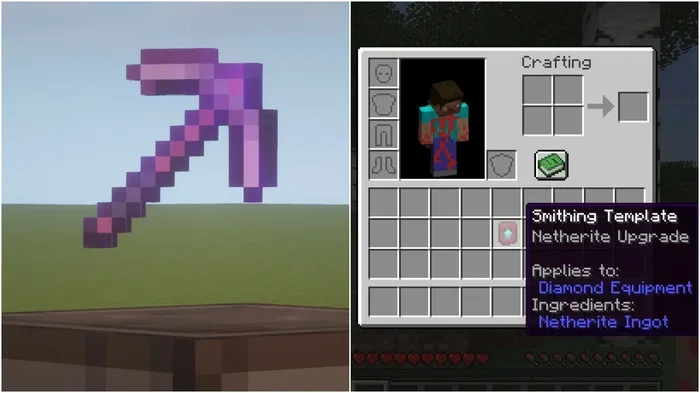
This is the moment you have been waiting for. The smithing table is the only block that can upgrade diamond gear to netherite. You cannot use a crafting table or any other method.
Here is how the smithing table upgrade works:
- Place the smithing table in your world and interact with it.
- Put your diamond tool in the left slot.
- Place a netherite ingot in the right slot.
- The upgraded netherite tool will appear in the output slot.
- Take your new netherite tool.
That is it. Your diamond tool is now netherite. All enchantments, custom names, and durability levels carry over perfectly. You do not lose anything in the process.
What About Armor?
The smithing table works the same way for armor. You can upgrade diamond helmets, chestplates, leggings, and boots to netherite using the same method. Just place the diamond armor piece in the left slot and a netherite ingot in the right slot.
Netherite armor is the best armor in the game. It provides more protection than diamond and gives you that small knockback resistance bonus. It is essential for fighting the Ender Dragon and exploring the End City.
Step 6: Repair and Maintain Your Netherite Gear
Netherite tools last a long time, but they are not indestructible. Eventually, even the best gear will need repair. Here is how to keep your netherite tools in top shape.
You have two main options for repair:
- Anvil repair: Combine two damaged netherite tools on an anvil. The durability of both tools adds together, plus a small bonus. This costs experience levels but preserves all enchantments.
- Grindstone repair: Place two damaged netherite tools on a grindstone. This restores some durability but removes all enchantments. Use this only for unenchanted gear.
For the best results, always use an anvil to repair netherite tools. This way, you keep every enchantment you have worked hard to apply.
Common Mistakes to Avoid
Even experienced players make mistakes when working with netherite. Here are some pitfalls to watch out for:
- Upgrading in the wrong order: Always upgrade to netherite as the final step. Do not enchant a netherite tool first and then try to upgrade it, because the enchantments will transfer correctly only when you upgrade from diamond.
- Using the wrong crafting table: A crafting table will not upgrade tools. You must use a smithing table.
- Not bringing enough ingots: Always bring more netherite ingots than you think you need. It is better to have extras than to run out.
- Dropping tools in lava carelessly: Even though netherite floats in lava, you should still be careful. Losing tools to lava is preventable.
Avoiding these mistakes saves you time, resources, and frustration. Take your time and follow each step carefully.
Netherite vs Diamond: A Quick Comparison
To help you understand the full value of netherite, here is a quick comparison of netherite and diamond tools across the most important categories.
| Feature | Diamond | Netherite |
|---|---|---|
| Durability | High | Higher |
| Attack Damage | Base + Enchantments | Higher Base + Enchantments |
| Lava Resistance | Burns and drops | Floats and survives |
| Enchantment Capacity | Good | Better |
| Armor Toughness | 2 per piece | 3 per piece |
| Knockback Resistance | None | Small amount |
| Upgrade Path | N/A (top tier) | Requires diamond base |
The table makes it clear. Netherite is the superior choice in every category. The only downside is the effort required to obtain it. But once you have a full set of netherite gear, nothing in Minecraft can stop you.
Final Thoughts
Upgrading your tools to netherite is one of the most satisfying experiences in Minecraft. It requires patience, resource gathering, and a bit of Nether survival skill. But the result is gear that outperforms everything else in the game.
Remember the steps: gather diamond tools, mine ancient debris in the Nether, smelt it into netherite scraps, combine with gold ingots, and use a smithing table to complete the upgrade. Each step builds on the last, and the process becomes faster once you know what you are doing.
If you are serious about Minecraft, netherite gear is not optional. It is essential. Start your upgrade journey today and experience the full power of the best material in the game.
For more helpful tool guides and tips, check out our other articles on tool usage and maintenance. Whether you are working with compressors or other equipment, we have guides to help you get the most out of your gear.
Now go mine that ancient debris and claim the power of netherite. Your diamond tools have served you well, but netherite is where the real adventure begins.
Frequently Asked Questions
Can you upgrade any diamond tool to netherite?
Yes, you can upgrade any diamond tool to netherite using a smithing table. This includes pickaxes, swords, axes, shovels, and hoes. You can also upgrade diamond armor pieces the same way. The enchantments on your diamond gear transfer over automatically during the upgrade process.
How many ancient debris blocks do I need for a full tool set?
Each netherite ingot requires two ancient debris blocks. To upgrade a full set of diamond armor (helmet, chestplate, leggings, and boots), you need four netherite ingots, which means eight ancient debris blocks. Add more for tools like pickaxes and swords. Always mine extra to be safe.
Do I lose my enchantments when upgrading to netherite?
No, you do not lose any enchantments. All enchantments, custom names, and durability levels carry over perfectly when you upgrade diamond gear to netherite using a smithing table. This is one of the biggest advantages of the upgrade process.
Can you find netherite ingots naturally in Minecraft?
No, netherite ingots cannot be found naturally as dropped items. You must craft them yourself by combining netherite scraps with gold ingots. Netherite scraps come from smelting ancient debris, which you mine in the Nether. Piglins may also give you gold ingots through bartering.
What is the best Y-level to mine for ancient debris?
The best Y-level to mine for ancient debris is between 8 and 22, with Y-15 being the most popular choice. Ancient debris generates most frequently in this range. Use a diamond or netherite pickaxe and always bring plenty of blocks to protect yourself from lava.
Can netherite tools break in lava?
No, netherite tools cannot break in lava. If you drop a netherite tool in lava, it will float on the surface and remain completely intact. You can pick it up and use it again. This is one of the most valuable properties of netherite gear in Minecraft.
=== INTERNAL LINKS ===
For more practical tool guides, check out our article on how to use an air compressor if you work with pneumatic tools. You might also find our guide on understanding how a 2 stage compressor works helpful for equipment maintenance. Finally, learn more about using a compressor pedal for precise tool control.