What Tools Do Dentists Use to Clean Your Teeth Properly
Dentists use a range of specialized tools to clean your teeth thoroughly and safely. From ultrasonic scalers that break up tartar to polishing cups that make your smile shine, each tool serves a specific purpose. Understanding these instruments helps you feel more comfortable during your next visit. This guide covers every major tool a dentist uses during a professional teeth cleaning.
Have you ever wondered what tools do dentists use to clean teeth during a routine visit? You might picture a bright light, a little mirror, and some sharp-looking metal tools. But the reality is much more interesting than that. Modern dentistry has a whole arsenal of specialized instruments designed to make your cleaning thorough, comfortable, and effective. Each tool has a specific job, and together they ensure your teeth and gums stay healthy.
Understanding these tools can take the mystery out of your dental visits. When you know what each instrument does, you feel more in control. You also appreciate the skill and care your dentist brings to every appointment. In this guide, we will walk you through every major tool used during a professional teeth cleaning. We will explain what each one does, why it matters, and how it keeps your smile bright.
Key Takeaways
- Dental mirrors and probes help dentists see and explore every surface of your teeth.
- Ultrasonic scalers use vibrations to remove tough tartar buildup quickly and comfortably.
- Hand instruments like curettes and scalers allow precise cleaning in tight spots.
- Polishing tools and fluoride treatments protect your teeth after the cleaning is done.
- Dental compressors power key equipment like handpieces and air-water syringes used during cleanings.
- Knowing what to expect reduces anxiety and helps you appreciate the care your dentist provides.
📑 Table of Contents
- What Tools Do Dentists Use to Clean Teeth: The Basics
- Dental Mirrors and Probes: The Eyes and Fingers of Your Dentist
- Ultrasonic Scalers: The Powerhouses of Tartar Removal
- Hand Instruments: Precision Cleaning for Tight Spaces
- Polishing Tools: Making Your Teeth Smooth and Shiny
- Fluoride Treatment: Protecting Your Teeth After Cleaning
- The Role of Dental Compressors in Modern Dentistry
- What to Expect During Your Next Cleaning
- Quick Tips for Keeping Your Teeth Clean Between Visits
- Common Mistakes People Make About Dental Cleanings
- Expert Insights: How Dentists Choose the Right Tools
- Key Takeaways
What Tools Do Dentists Use to Clean Teeth: The Basics
A professional dental cleaning involves several stages. Each stage uses different instruments to address specific needs. Your dentist starts by examining your mouth, then moves on to removing plaque and tartar, polishing your teeth, and finally applying protective treatments. Let us break down each step and the tools involved.
The entire process is designed to be thorough yet gentle. Dentists train for years to use these instruments safely and effectively. The goal is always to remove harmful buildup without damaging your enamel or irritating your gums. With the right tools and technique, a cleaning can leave your mouth feeling fresh and healthy.
Why Dental Cleaning Tools Matter
Using the right dental hygiene tools makes a huge difference in the quality of your cleaning. Generic tools simply cannot reach the tight spaces between teeth or below the gumline. Professional instruments are specifically designed for these challenges. They allow dentists to detect and remove problems early, before they turn into bigger issues.
Think of it like cooking. You would not use a dull knife to chop vegetables. The right tool makes the job easier, faster, and safer. The same principle applies to dental care. Each instrument is crafted with precision to deliver the best possible outcome for your oral health.
Dental Mirrors and Probes: The Eyes and Fingers of Your Dentist
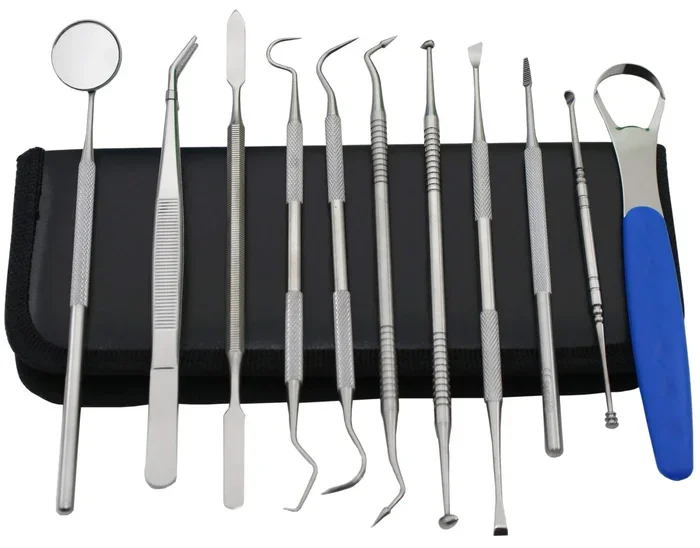
Every cleaning starts with a simple but essential tool: the dental mirror. This small, round mirror attached to a long handle lets your dentist see every surface of your teeth. It reflects light into dark corners of your mouth that would otherwise be hidden. Without it, your dentist would be working blind in many areas.
The dental probe is the perfect companion to the mirror. This thin, pointed instrument helps dentists explore the surfaces of your teeth and measure the depth of spaces between your teeth and gums. A periodontal probe specifically checks for gum disease by measuring pocket depths. These basic tools have been part of dentistry for over a century, and they remain indispensable today.
Types of Dental Mirrors
Dentists use several sizes of mirrors depending on the area they are examining. A front-facing mirror gives a direct view of the front teeth. A side-facing mirror helps see the back molars. Some mirrors are double-sided for extra versatility. Each one is small enough to fit comfortably in your mouth without causing gagging.
How Probes Help Detect Problems Early
Your dentist uses the probe to check for soft spots on your enamel. These soft spots can signal early cavities. The probe also checks the firmness of your gum tissue. Healthy gums feel firm and snug around the teeth. Soft or bleeding areas may indicate gingivitis or gum disease. Catching these signs early leads to simpler, less invasive treatment.
Ultrasonic Scalers: The Powerhouses of Tartar Removal
If you have ever heard a humming sound during your cleaning, that was likely an ultrasonic scaler at work. This is one of the most important tools dentists use to clean teeth today. An ultrasonic scaler uses rapid vibrations to break up stubborn tartar and plaque buildup. A steady stream of water washes away the debris as the tool works.
Many people worry that ultrasonic scaling feels uncomfortable. In reality, most patients find it quite comfortable. The vibrations are gentle, and the water keeps the area cool. Your dentist can adjust the intensity based on your comfort level. This tool is especially effective for removing large deposits of calculus that hand tools alone cannot handle.
How Ultrasonic Scalers Work
The tip of the scaler vibrates at a very high frequency, often between 25,000 and 50,000 cycles per second. These rapid vibrations break the bond between tartar and the tooth surface. The water spray cools the tip and flushes away the loosened particles. Your dentist moves the tip along the tooth surface, targeting areas of heavy buildup.
Some ultrasonic scalers also produce a cavitation effect. This creates tiny bubbles in the water that burst and release energy. The energy helps disrupt bacterial cells, adding a disinfecting benefit to the cleaning process. It is a smart design that does more than just scrape away buildup.
Benefits of Ultrasonic Scaling
- Faster cleaning: Ultrasonic scalers cover more surface area in less time.
- Deeper cleaning: They reach below the gumline more effectively than hand tools alone.
- More comfortable: Many patients prefer the gentle vibrations over manual scraping.
- Better visibility: The water spray keeps the field clear so your dentist can see clearly.
Hand Instruments: Precision Cleaning for Tight Spaces
Even with ultrasonic scalers, dentists still rely on hand instruments for detailed work. These manual tools give your dentist fine control in tight spaces. Two of the most common hand instruments are scalers and curettes. While they look similar, each serves a slightly different purpose in the cleaning process.
Scalers are designed to remove plaque and tartar from the crown of the tooth, the part above the gumline. They have a sharp, pointed tip that can target specific buildup spots. Curettes, on the other hand, have a rounded tip that works well below the gumline. Your dentist uses both to ensure a complete cleaning from top to bottom.
The Scaling Process Step by Step
- Your dentist identifies areas of buildup using the probe and mirror.
- An ultrasonic scaler removes the bulk of the tartar.
- Hand scalers and curettes refine the cleaning in hard-to-reach spots.
- The dentist checks for any remaining deposits and smooths the tooth surface.
This layered approach ensures nothing is missed. The combination of power tools and hand instruments gives your dentist the best of both worlds. Speed and precision work together to deliver a thorough cleaning every time.
Why Hand Instruments Still Matter
You might wonder why dentists bother with hand tools when ultrasonic scalers exist. The answer is precision. Ultrasonic scalers are excellent for broad coverage, but hand instruments allow your dentist to feel the tooth surface closely. They can detect tiny ridges or rough spots that vibrations alone might miss. This tactile feedback is invaluable for a perfect finish.
Polishing Tools: Making Your Teeth Smooth and Shiny
After all the tartar and plaque are removed, the next step is polishing. This is the part of the cleaning that leaves your mouth feeling incredibly smooth and fresh. Dentists use a small rubber cup or brush attached to a slow-speed handpiece. The cup spins gently while polishing paste is applied to your teeth.
The polishing paste contains mild abrasives that buff away surface stains. It also smooths out tiny imperfections on the enamel. A smooth tooth surface is harder for plaque to stick to, which means your teeth stay cleaner longer between visits. This is one of the simplest yet most effective parts of the entire cleaning process.
Types of Polishing Pastes
Dentists have several polishing paste options to choose from. Some pastes are grittier and work well for heavy staining from coffee or tea. Others are finer and gentler, ideal for patients with sensitive teeth. Your dentist selects the right paste based on your needs and the condition of your enamel.
The polishing process usually takes just a few minutes per quadrant of your mouth. You will feel the gentle spinning and taste the minty paste. Most people find this part of the cleaning very pleasant. It is a satisfying finish that leaves your smile looking and feeling its best.
The Prophylaxis Angle
Many dentists use a tool called a prophylaxis angle to hold the polishing cup. This device attaches to the handpiece and holds the cup at the perfect angle for efficient polishing. It saves time and ensures consistent pressure across all tooth surfaces. The prophylaxis angle is a small but important part of the polishing toolkit.
Fluoride Treatment: Protecting Your Teeth After Cleaning
A professional cleaning often ends with a fluoride treatment. Fluoride is a natural mineral that strengthens tooth enamel and helps prevent cavities. After removing all the buildup, your teeth are more vulnerable to new bacteria. Fluoride provides a protective shield that keeps your smile healthy until your next visit.
Dentists apply fluoride in several forms. A gel or foam is placed in a tray that fits over your teeth. You hold it in your mouth for about one minute. Some dentists also apply fluoride varnish directly to the tooth surface. The varnish hardens quickly and continues to protect your teeth for several hours after the appointment.
Why Fluoride Matters
Fluoride helps rebuild weakened enamel through a process called remineralization. It replaces lost minerals in the tooth surface, making it more resistant to acid attacks from bacteria. This is especially important for people prone to cavities or those with gum recession that exposes root surfaces.
Most dentists recommend fluoride treatments as part of every routine cleaning. For children, it is especially important during the years when permanent teeth are coming in. Adults benefit just as much, though. Strong enamel is the best defense against tooth decay at any age.
The Role of Dental Compressors in Modern Dentistry
You might not think about it, but compressors play a vital role in dental cleanings. Many of the tools your dentist uses during your appointment are powered by compressed air. From the high-speed handpiece that polishes your teeth to the air-water syringe that keeps your mouth dry, compressors make it all possible.
Dental offices rely on a steady supply of clean, dry compressed air. The compressor must meet strict standards for purity and pressure. Contaminated air can introduce bacteria into your mouth, which is exactly what a cleaning is trying to prevent. This is why regular maintenance of dental compressors is so important.
How Dental Compressors Support Cleanings
During your cleaning, your dentist uses an air-water syringe to rinse and dry each tooth. This tool sprays a combination of air and water to keep the area clear and visible. The compressed air powers the spray, giving your dentist control over the flow and pressure.
The handpiece used for polishing also runs on compressed air or electric power. A properly maintained compressor delivers consistent performance throughout your appointment. If the compressor is not working right, it can slow down the cleaning and affect the quality of the results.
Just like any other equipment, dental compressors need regular care. Dentists must use the right oil and follow proper maintenance schedules. For those interested in compressor maintenance, you can learn more about easy air compressor how to use and getting more CFM from your compressor. Proper maintenance ensures the compressor runs smoothly and delivers the consistent air pressure that dental procedures demand.
Choosing the Right Compressor for Dental Use
Not all compressors are suitable for dental work. Dental compressors need to be oil-free or use specific filtration to prevent contamination. They must also maintain a steady pressure level without short cycling, which can disrupt procedures. Dentists invest in quality compressors because reliability directly affects patient care and outcomes.
Using the wrong oil in a dental compressor can lead to serious problems. It is important to follow the manufacturer guidelines and use only approved lubricants. You can find more information about what oil does an air compressor take to understand the importance of proper lubrication in dental and general compressor applications.
Common Compressor Issues in Dental Offices
One problem dentists watch for is compressor short cycling, which happens when the unit turns on and off too frequently. This can indicate an air leak or an improperly sized tank. Short cycling puts extra wear on the motor and reduces the lifespan of the equipment. Regular inspections help catch these issues early.
Another concern is moisture buildup in the lines. Too much moisture in the compressed air can damage dental instruments and create an unhygienic environment. Dentists use air dryers and filters to keep the moisture levels low. These simple additions make a big difference in the quality and safety of dental care.
What to Expect During Your Next Cleaning
Now that you know about the tools involved, you can walk into your next appointment with confidence. A typical professional cleaning takes between 30 and 60 minutes, depending on the condition of your teeth and gums. Here is a quick overview of what happens from start to finish.
First, your dentist or hygienist will examine your mouth using a mirror and probe. They look for signs of inflammation, cavities, or other concerns. Next, they use an ultrasonic scaler to remove large tartar deposits. Hand instruments follow to refine the cleaning in tight spaces. After rinsing, they polish your teeth with a rubber cup and paste. Finally, fluoride treatment is applied for added protection.
Throughout the process, your comfort is the top priority. If you feel any sensitivity or discomfort, let your dentist know. They can adjust their technique or use a numbing gel to make the experience more pleasant. Modern dental tools are designed with patient comfort in mind, so cleanings are usually much more comfortable than people expect.
Regular cleanings every six months help prevent serious dental problems. They also give your dentist a chance to catch issues early when they are easiest to treat. By understanding the tools and process, you can approach each visit with a positive attitude and a sense of empowerment.
Quick Tips for Keeping Your Teeth Clean Between Visits
While your dentist has the best tools for a deep cleaning, your daily habits matter just as much. Here are some quick tips to keep your teeth in great shape between appointments:
- Brush twice a day with a soft-bristled toothbrush and fluoride toothpaste.
- Floss daily to remove plaque from between teeth where your brush cannot reach.
- Use an antiseptic mouthwash to reduce bacteria and freshen your breath.
- Limit sugary foods and drinks that feed cavity-causing bacteria.
- Drink plenty of water to wash away food particles and keep your mouth moist.
- Replace your toothbrush every three to four months for best results.
These simple habits complement the work your dentist does during cleanings. Together, they form a strong defense against plaque, tartar, and gum disease. The better you care for your teeth at home, the easier and quicker your professional cleanings become.
Common Mistakes People Make About Dental Cleanings
Many people underestimate the importance of regular dental cleanings. Some skip appointments because they feel their teeth look and feel fine. Others avoid the dentist because of anxiety or fear of the tools. Understanding what really happens during a cleaning can help overcome these barriers.
Another common mistake is thinking that brushing alone is enough. Even the best toothbrush cannot remove all tartar buildup. Once tartar hardens on your teeth, only professional instruments can remove it safely. Trying to scrape tartar off at home with sharp tools can damage your enamel and hurt your gums. Always leave tartar removal to the professionals.
Some people also believe that cleanings make teeth weaker or more sensitive. In reality, cleanings strengthen teeth by removing harmful buildup and applying fluoride. Any temporary sensitivity usually fades within a day or two. The long-term benefits far outweigh any brief discomfort.
Expert Insights: How Dentists Choose the Right Tools
Experienced dentists select their tools based on each patient’s unique needs. A patient with heavy tartar buildup may need more ultrasonic scaling. Someone with sensitive gums might benefit from gentler hand instruments and a finer polishing paste. The best dentists tailor their approach to deliver the most effective and comfortable cleaning possible.
Technology continues to evolve in dentistry. New tools make cleanings faster, quieter, and more comfortable than ever before. Digital imaging, laser diagnostics, and advanced ultrasonic tips are just a few examples. Dentists who stay current with these innovations provide a higher level of care to their patients.
The key takeaway is that every tool in a dentist’s toolkit serves an important purpose. None of them are there by accident. Each instrument is chosen for its ability to clean effectively while protecting your comfort and oral health. When you see all those tools laid out, remember that they all work together to give you the best possible cleaning.
Key Takeaways
- Dental mirrors and probes are the foundational tools for examining and exploring your teeth during a cleaning.
- Ultrasonic scalers use high-frequency vibrations and water to break up and flush away tough tartar deposits.
- Hand instruments like scalers and curettes provide the precision needed for detailed cleaning in tight spaces.
- Polishing tools and prophylaxis angles smooth enamel surfaces and remove surface stains for a brighter smile.
- Fluoride treatments strengthen enamel and protect against cavities after the cleaning is complete.
- Dental compressors power essential equipment including handpieces and air-water syringes used throughout the cleaning process. Proper maintenance, including using the right oil and preventing issues like short cycling, ensures reliable performance.
- Regular cleanings combined with good home care are the best strategy for long-term oral health.
Frequently Asked Questions
What tools do dentists use to clean teeth during a typical visit?
Dentists use several tools during a typical cleaning, including dental mirrors, probes, ultrasonic scalers, hand scalers, curettes, polishing cups, and air-water syringes. Each tool serves a specific purpose in removing plaque, tartar, and surface stains while keeping your mouth comfortable and clear throughout the procedure.
Do ultrasonic scalers hurt during teeth cleaning?
Most patients find ultrasonic scalers quite comfortable. The vibrations are gentle, and the water spray keeps the area cool. If you have sensitive teeth, your dentist can adjust the intensity or use a numbing gel to ensure your comfort throughout the cleaning process.
Why do dentists use compressors during cleanings?
Dental compressors power key equipment like air-water syringes and handpieces used during cleanings. They provide the compressed air needed for rinsing, drying, and polishing your teeth. A well-maintained compressor ensures consistent performance and safe, hygienic air delivery throughout your appointment.
How often should you get a professional teeth cleaning?
Most dentists recommend a professional cleaning every six months. However, patients with gum disease or heavy tartar buildup may need cleanings more frequently. Your dentist will create a personalized schedule based on your oral health needs and risk factors.
Can polishing damage tooth enamel?
No, professional polishing is safe and does not damage enamel. Dentists use specially formulated polishing pastes with mild abrasives that smooth the surface without wearing it down. The process actually helps make your teeth more resistant to plaque buildup between visits.
What is the difference between scaling and polishing during a dental cleaning?
Scaling focuses on removing plaque and tartar buildup from tooth surfaces, especially below the gumline. Polishing comes after scaling and uses a rubber cup with abrasive paste to smooth the enamel and remove surface stains. Together, they provide a complete cleaning that protects your oral health.
=== CONCLUSION ===
Now you have a clear picture of what tools do dentists use to clean teeth properly. From the humble dental mirror to the powerful ultrasonic scaler, each instrument plays a vital role in keeping your smile healthy. The combination of precision hand tools, advanced ultrasonic technology, polishing instruments, and protective fluoride treatments creates a comprehensive cleaning experience that is both effective and comfortable.
Understanding these tools also helps you appreciate the expertise your dentist brings to every appointment. Years of training go into mastering each instrument and technique. The next time you sit in the dental chair, you can feel confident knowing that every tool being used is there for a specific, important reason.
Regular cleanings are one of the best investments you can make in your oral health. They prevent costly procedures down the road and keep your natural teeth strong for life. So schedule your next appointment, ask questions, and take an active role in your dental care. Your smile will thank you for it.