What Is the Most Common Cause of Compressor Failure
The most common cause of compressor failure is refrigerant issues, especially improper charge levels and leaks. When a compressor runs with too little or too much refrigerant, it puts severe strain on the system, leading to overheating, motor burnout, and total breakdown. Understanding this root cause helps you take simple preventive steps that save money and extend compressor life.
Key Takeaways
- Refrigerant problems are the #1 culprit: Low or high refrigerant charge is the single most common cause of compressor failure.
- Lubrication matters just as much: Without proper oil flow, compressor parts grind down and seize up quickly.
- Electrical issues sneak up on you: Worn windings, voltage imbalances, and short cycling can destroy a compressor over time.
- Overheating is a silent killer: Poor airflow, dirty coils, and high ambient temperatures push compressors past their limits.
- Prevention is simple and cheap: Regular maintenance, proper charge levels, and clean components can double compressor lifespan.
- Know when to call a pro: Some warning signs like strange noises or warm air mean you need immediate attention.
📑 Table of Contents
- Understanding How Compressors Work and Why They Fail
- The Number One Cause: Refrigerant Issues
- Lubrication Failure and Its Impact on Compressors
- Electrical Problems That Destroy Compressors
- Overheating: The Silent Killer of Compressors
- Contamination and Environmental Factors
- How to Prevent Compressor Failure Before It Happens
- Conclusion
Understanding How Compressors Work and Why They Fail
Compressors are the heart of any cooling or refrigeration system. They pressurize refrigerant gas and push it through the system to create cool air. Without a working compressor, your air conditioner, refrigerator, or industrial system simply stops cooling. That is why compressor failure is such a big deal.
When a compressor dies, it is not just an inconvenience. It can cost hundreds or even thousands of dollars to replace. The good news is that most compressor failures are not random. They happen for a reason, and that reason is almost always something you can prevent. The most common cause of compressor failure comes down to a few key culprits that we will break down in this article.
Whether you are dealing with an HVAC compressor at home or a large industrial unit, the basics are the same. Compressors need the right amount of refrigerant, clean oil, stable electricity, and proper airflow. When any one of these is off, the compressor starts to struggle. Over time, that struggle turns into permanent damage.
In this guide, we will walk through each cause in detail. You will learn what to watch for, how to prevent problems, and what to do when something goes wrong. Let us get into it.
The Number One Cause: Refrigerant Issues
If you had to pick one reason compressors fail more than any other, it would be refrigerant problems. The refrigerant is the lifeblood of the cooling cycle. It absorbs heat from inside your space and carries it outside. When the refrigerant level is wrong, the entire system suffers.
Low Refrigerant Charge
A low refrigerant charge is the most dangerous situation for any compressor. When there is not enough refrigerant flowing through the system, the compressor has to work much harder to do its job. It runs hotter, draws more current, and wears out faster.
Low refrigerant usually happens because of a refrigerant leak. Small leaks develop over time in the refrigerant line, fittings, or coils. You might not notice a slow leak at first, but the effects on the compressor add up quickly.
Here are common signs of a low refrigerant charge:
- The system takes longer to cool your space
- Ice builds up on the evaporator coils
- You hear bubbling or hissing sounds near the unit
- The air coming out feels warm or barely cool
- Your electricity bills start creeping up
When a compressor runs low on refrigerant for too long, the compressor motor burnout becomes almost inevitable. The motor overheats, the winding insulation breaks down, and the compressor locks up. At that point, compressor replacement cost is usually the only option.
Too Much Refrigerant
Here is something many people do not expect. Too much refrigerant can be just as bad as too little. When the system is overcharged, liquid refrigerant can flood back into the compressor. This is called compressor flooding, and it washes away the oil that keeps internal parts lubricated.
The result is the same as running low on refrigerant: increased wear, overheating, and eventually failure. This is why proper refrigerant charge during installation and maintenance is so critical. Always have a licensed technician handle refrigerant charging.
How Refrigerant Problems Connect to Generator Use
If you are using a generator to power your cooling system, refrigerant issues can hit even harder. A generator that is not properly sized may deliver unstable voltage, which compounds the stress on an already struggling compressor. For example, running an RV air conditioner on an undersized unit puts extra strain on the AC compressor. If you want to learn more about sizing your generator correctly, check out this guide on What Size Generator For 30 Amp Rv Air Conditioner.
Lubrication Failure and Its Impact on Compressors
Compressors have many moving parts that spin, slide, and grind against each other. Without proper lubrication, those parts create friction, heat, and metal-on-metal wear. Over time, this destroys the compressor from the inside out.
The Role of Compressor Oil
Compressor oil serves two main jobs. It lubricates the moving parts and it helps seal the compression chambers. When the oil level drops or the oil becomes contaminated, neither job gets done properly.
Contamination is a big problem. Moisture, dirt, and metal particles can get into the oil through leaks or worn components. Dirty oil does not flow as well, which means parts do not get the lubrication they need. This creates a vicious cycle: poor lubrication causes more wear, which creates more particles, which contaminates the oil even further.
Here is what you can do to protect your compressor from lubrication issues:
- Check oil levels regularly according to the manufacturer’s schedule
- Replace oil and filters at recommended intervals
- Watch for signs of oil contamination, such as dark or gritty oil
- Fix refrigerant leaks quickly, since refrigerant and oil systems are connected
- Use only the oil type recommended for your specific compressor model
How Lack of Lubrication Leads to Compressor Lockup
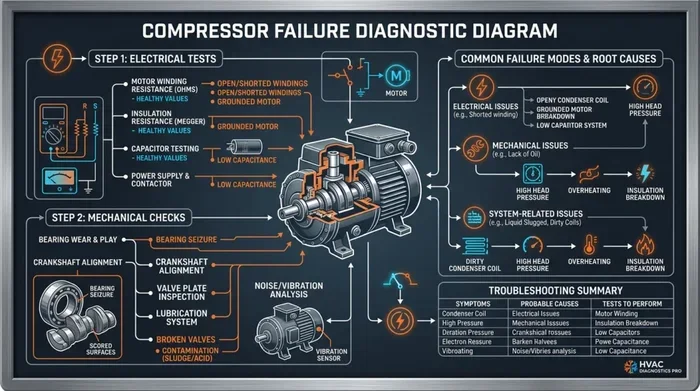
When a compressor runs without enough oil, the internal components seize. This is called a compressor lockup. The motor tries to turn the seized pump but draws extremely high current. The thermal overload kicks in, or worse, the motor winding burns out.
A locked compressor usually cannot be repaired. It needs to be replaced entirely. This is why lubrication maintenance is one of the simplest and most cost-effective ways to prevent compressor failure.
Electrical Problems That Destroy Compressors
Electricity is what makes a compressor run, but electrical problems are also one of the leading causes of premature failure. Many people do not realize how sensitive compressors are to electrical issues.
Voltage Imbalance
In three-phase compressor systems, voltage imbalance between phases is a common problem. Even a small imbalance of just 2% can cause a 15% to 20% increase in motor winding temperature. Over months and years, this extra heat degrades the insulation and burns out the motor.
Voltage imbalance usually comes from uneven loads on the electrical supply, loose connections, or a failing power supply. Regular electrical checks can catch these problems early.
Short Cycling
Compressor short cycling happens when the unit turns on and off too frequently. Each start-up draws a surge of current that is many times higher than normal running current. All those frequent surges wear out the motor windings and mechanical components much faster than normal operation.
Short cycling can be caused by a thermostat set too tight, a clogged air filter, or an oversized system. If your compressor is turning on and off every few minutes, that is a serious warning sign that needs attention right away.
Wiring and Connection Issues
Loose or corroded electrical connections create resistance in the circuit. That resistance generates heat at the connection points, which can melt wire insulation and cause shorts. In severe cases, this leads to a complete electrical failure that takes out the compressor and potentially other system components.
Make it a habit to inspect electrical connections during routine maintenance. Tighten any loose terminals and replace any wires that show signs of heat damage or corrosion.
Overheating: The Silent Killer of Compressors
Overheating is one of the most common contributors to compressor failure, and it often goes unnoticed until it is too late. Compressors generate a lot of heat during normal operation, and they rely on proper airflow and ambient conditions to stay within safe temperature ranges.
What Causes Compressor Overheating
Several factors can push a compressor past its safe operating temperature:
- Dirty condenser coils: Clogged coils cannot release heat properly, causing the system to overheat.
- Poor airflow: Blocked vents, dirty filters, or obstructed units restrict the air needed for cooling.
- High ambient temperatures: Running a compressor in extreme heat without adequate ventilation accelerates thermal stress.
- Low refrigerant: As we discussed earlier, low charge causes the compressor to overwork and generate excess heat.
- Motor overload: When the compressor draws more current than designed, the windings heat up rapidly.
The Effect of Overheating on Compressor Lifespan
Every time a compressor overheats, it damages the motor winding insulation a little more. Over time, that insulation breaks down completely, and the motor shorts out. A well-maintained compressor can last 15 to 20 years. An overheated compressor might fail in 5 to 7 years.
The difference is entirely about maintenance and operating conditions. Keeping coils clean, ensuring proper airflow, and monitoring refrigerant levels are the best ways to prevent compressor overheating and extend compressor lifespan.
For those running cooling systems on generators, overheating is even more of a concern because generators can produce additional heat in enclosed spaces. If you are using a generator to power a refrigerator compressor, make sure the generator is properly sized. You can read more about sizing a generator for a refrigerator in this guide on What Size Generator To Run A Refrigerator.
Contamination and Environmental Factors
Compressors do not operate in a vacuum. They are exposed to dust, moisture, chemicals, and other contaminants that can slowly degrade their performance and lead to failure.
Moisture and Corrosion
Moisture inside the refrigerant system is a serious problem. When water mixes with refrigerant, it creates hydrochloric acid, which corrodes metal components and damages the compressor motor windings. This is why proper evacuation and charging during installation is so important.
Moisture can enter the system through leaks, improper servicing, or degraded seals. Once inside, it is very difficult to remove completely and will continue to cause damage over time.
Dust and Debris
In industrial or construction environments, dust and debris can clog air filters, coat condenser coils, and work their way into internal compressor components. This restricts airflow, reduces heat dissipation, and accelerates wear on moving parts.
Regular cleaning and filter replacement go a long way in preventing contamination-related compressor failure. If you are working in a dusty environment, consider more frequent maintenance intervals.
Chemical Exposure
Some environments expose compressors to chemicals, fumes, or gases that can corrode metal parts or degrade rubber seals and gaskets. If your compressor operates near industrial processes or cleaning chemicals, make sure it is housed in a protective enclosure and inspected regularly for signs of corrosion.
Interestingly, air quality around compressors can also be affected by nearby equipment. For instance, some facilities use an ozone generator for air purification, which can interact with compressor operating environments. Understanding these interactions helps you make better decisions about equipment placement and maintenance schedules.
How to Prevent Compressor Failure Before It Happens
The best way to deal with compressor failure is to prevent it from happening in the first place. Fortunately, most preventive measures are simple, affordable, and easy to incorporate into your routine.
Stick to a Regular Maintenance Schedule
Create a maintenance calendar and follow it religiously. At minimum, your compressor should receive professional inspection and servicing once a year. During these visits, a technician should check refrigerant levels, inspect electrical connections, clean coils, and evaluate the condition of the oil.
Monitor Your System Daily
You do not need to be a professional to spot early warning signs. Here is what to watch for every day:
- Unusual noises like grinding, clicking, or rattling
- Warm air coming from vents instead of cool air
- Ice buildup on refrigerant lines or coils
- Frequent cycling on and off
- Unusual vibrations or humming
- Higher than normal energy bills
Catching these signs early and calling a technician can prevent a small problem from becoming a compressor replacement situation.
Keep Components Clean
Dirty coils, clogged filters, and blocked vents are the enemies of any compressor. Make it a habit to clean or replace filters monthly during heavy use seasons. Clean condenser coils at least twice a year, or more often in dusty environments.
Ensure Proper Installation
Many compressor failures trace back to poor installation. Incorrect refrigerant charge, undersized electrical wiring, and improper airflow setup all shorten compressor life. Always hire qualified professionals for installation and never skip the commissioning process.
Use the Right Equipment for the Job
Matching your compressor to its intended load is critical. An oversized or undersized compressor will experience problems no matter how well you maintain it. If you are running power tools or appliances that depend on a compressor, make sure your power source is adequate. For guidance on generator sizing, check out this article on What Size Generator Do I Need To Run Power Tools.
Address Problems Immediately
Do not ignore warning signs or put off repairs hoping the problem will go away. Compressors do not forgive neglect. A small refrigerant leak today becomes a burned-out motor next month. Quick action on small problems saves you from expensive compressor troubleshooting and replacement down the road.
Conclusion
The most common cause of compressor failure is refrigerant issues, closely followed by lubrication problems, electrical faults, and overheating. The good news is that all of these causes are preventable with proper maintenance and attention.
By keeping your refrigerant charge at the right level, ensuring proper lubrication, maintaining clean electrical connections, and preventing overheating, you can dramatically extend the life of your compressor. A well-maintained compressor can serve you reliably for 15 to 20 years or more.
Take the time to understand your compressor, follow the manufacturer’s maintenance recommendations, and do not ignore warning signs. Your compressor works hard for you every day. A little preventive care goes a long way toward keeping it running smoothly and avoiding costly repairs.
If you suspect something is wrong with your compressor, do not wait. Call a qualified technician, check your refrigerant levels, and inspect your system for the early signs we discussed. Acting now could save you from a major breakdown and a significant expense.
Frequently Asked Questions
What is the most common cause of compressor failure?
The most common cause is refrigerant issues, particularly low refrigerant charge due to leaks or improper charge levels. When the refrigerant is too low or too high, the compressor has to work harder, leading to overheating, motor burnout, and eventual failure. Regular maintenance and proper refrigerant management can prevent this.
How do I know if my compressor is failing?
Watch for warning signs like warm air from vents, unusual noises, frequent cycling, ice buildup on coils, and higher energy bills. These are all indicators that your compressor is struggling. Catching these signs early gives you the best chance to fix the problem before a full failure occurs.
Can a compressor be repaired instead of replaced?
In some cases, yes. Electrical issues, minor refrigerant leaks, or lubrication problems can often be repaired without replacing the entire compressor. However, if the motor windings are burned out or the compressor has locked up, replacement is usually the only option. A professional technician can assess the damage and recommend the best course of action.
How long should a compressor last?
A well-maintained compressor typically lasts 15 to 20 years. However, compressors that are poorly maintained, run with incorrect refrigerant levels, or operate in harsh conditions may fail in as little as 5 to 7 years. Regular maintenance is the single biggest factor in extending compressor lifespan.
Does running a compressor on a generator cause failure?
Not if the generator is properly sized and maintained. An undersized or unstable generator can deliver inconsistent voltage, which puts extra stress on the compressor motor. Make sure your generator matches the power requirements of your compressor system. You can learn more about proper sizing in our guide on What Size Generator To Run A Refrigerator.
What is the cheapest way to prevent compressor failure?
The cheapest way is regular filter cleaning or replacement and keeping the coils clean. These simple tasks cost almost nothing but prevent overheating, improve airflow, and reduce strain on the compressor. Adding routine refrigerant level checks to your maintenance schedule is another low-cost step that pays off significantly.