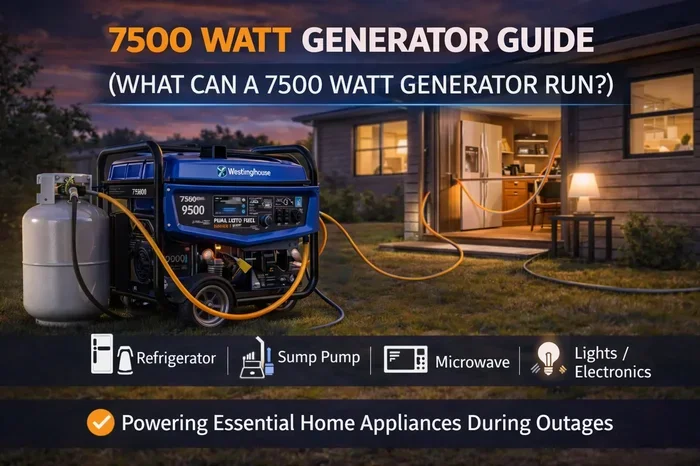
7500 Watt Generator What Will It Run And Power Your
A 7500 watt generator is one of the most versatile power sources for homes, job sites, and outdoor events. So what will a 7500 watt generator run? It can handle most essential household appliances, power tools, and even some larger electronics — making it a top choice for backup power and emergency readiness.
Key Takeaways
- Versatile Power Output: A 7500 watt generator can run most essential home appliances, power tools, and medium-sized electronics simultaneously.
- Know Your Wattage: Understanding the difference between running watts and surge watts is critical when planning what to connect to your generator.
- Fuel Matters: Gasoline, propane, and natural gas options each offer different runtime and convenience levels for your 7500 watt unit.
- Safe Usage Is Essential: Always operate generators outdoors, avoid overloading circuits, and perform regular generator testing to ensure reliability.
- Proper Sizing Saves Money: Matching your generator to your actual power needs prevents wasted fuel and unnecessary costs.
- Maintenance Extends Life: Routine oil changes, filter checks, and load management keep your generator running strong for years.
📑 Table of Contents
- What a 7500 Watt Generator Can Run: A Complete Guide
- Understanding Wattage: Running Watts vs. Surge Watts
- What Will a 7500 Watt Generator Run?
- How to Calculate Your Power Needs
- Fuel Types and Runtime for a 7500 Watt Generator
- Best Practices for Running a 7500 Watt Generator Safely
- Tips for Maximizing Efficiency and Longevity
- Common Mistakes People Make With a 7500 Watt Generator
- Conclusion
What a 7500 Watt Generator Can Run: A Complete Guide
Power outages strike without warning. Storms roll in, grids fail, and suddenly you are left in the dark wondering how your family will cope. This is exactly why owning a reliable 7500 watt generator makes sense. But the real question most people ask is: 7500 watt generator what will it run?
The answer might surprise you. A 7500 watt generator is powerful enough to keep your refrigerator running, charge your phones, power your sump pump, and even run several power tools at the same time. It sits in that sweet spot between portability and raw power. Whether you need home backup power for a storm or a dependable workhorse for a construction site, this generator size delivers.
In this guide, we break down exactly what appliances, tools, and electronics a 7500 watt generator can handle. We also cover fuel consumption, runtime estimates, safety tips, and common mistakes to avoid. By the end, you will know precisely how to use every last watt of power this machine offers.
Understanding Wattage: Running Watts vs. Surge Watts
Before we dive into what a 7500 watt generator can run, you need to understand two important terms. Not all watts are created equal, and confusing these two numbers can lead to serious problems.
Running Watts
Running watts (also called continuous watts) are the steady power your generator produces nonstop. Think of this as the constant energy flow needed to keep a refrigerator humming or a light bulb glowing. If an appliance needs 1000 running watts, your generator must deliver that amount continuously.
Surge Watts
Surge watts (also called starting watts) are the extra power needed to start motor-driven appliances. Devices like air conditioners, refrigerators, and circular saws need a burst of energy when they first kick on. This spike can be two or three times the running wattage. Your generator must handle this temporary jump.
Here is a quick example. A window air conditioner might need 1200 running watts but require 3600 surge watts to start. If your 7500 watt generator cannot handle that surge, it will trip the breaker or shut down entirely. Always check both numbers before plugging anything in.
What Will a 7500 Watt Generator Run?
Now let us get to the heart of the matter. Below is a detailed breakdown of common household appliances and tools, along with their typical wattage requirements. This list answers the question 7500 watt generator what will it run with real numbers.
Essential Household Appliances
- Refrigerator: 1200 running watts, 2400 surge watts
- Freezer: 800 running watts, 1600 surge watts
- Microwave Oven: 1000 running watts, no significant surge
- Coffee Maker: 900 running watts
- Toaster: 1200 running watts
- Electric Stove (one burner): 1500 running watts
- Dishwasher: 1200 running watts, 2400 surge watts
- Sump Pump: 1300 running watts, 3000 surge watts
Electronics and Comfort Items
- TV (50-inch): 200 running watts
- Laptop: 50 running watts
- Smartphone Charger: 10 running watts
- Tablet Charger: 15 running watts
- Ceiling Fan: 100 running watts
- Space Heater (small): 1500 running watts
- Window Fan: 200 running watts
- Lighting (10 bulbs): 500 running watts total
Power Tools and Outdoor Equipment
- Drill: 600 running watts, 1200 surge watts
- Circular Saw: 1300 running watts, 2600 surge watts
- Angle Grinder: 900 running watts
- Air Compressor (small): 1000 running watts, 2000 surge watts
- Pressure Washer: 1500 running watts, 3000 surge watts
- Welder (light duty): 1500 running watts
As you can see, a 7500 watt generator handles a surprisingly wide range of devices. You could easily run a refrigerator, several lights, a TV, phone chargers, and a small heater all at the same time. That is more than enough to keep your family comfortable during a long power outage.
How to Calculate Your Power Needs
Knowing what a 7500 watt generator can run is one thing. Figuring out what you need it to run is another. Every household is different, and guessing leads to either an underpowered setup or wasted money on an oversized unit.
Step-by-Step Load Calculation
Follow these steps to determine your total power demand:
- List every appliance you want to run. Walk through your home and write down each device. Include the refrigerator, HVAC unit, lights, water heater, and any tools or electronics you plan to use.
- Find the wattage labels. Check the back of each appliance or look up the model number online. Focus on both the running watts and the surge watts.
- Add up the running watts. Total all the continuous wattage numbers. This gives you your baseline power need.
- Add the highest surge wattage. You only need to account for the largest single surge once, since not every appliance starts at the same time. Pick the biggest surge number from your list and add it to your running total.
- Compare against your generator capacity. If your total falls under 7500 watts, you are in good shape. If it exceeds 7500, you need to cut back or upgrade.
Quick Example
Say you want to run a refrigerator (1200 running, 2400 surge), a TV (200 running), phone chargers (50 running), ceiling fans (200 running), lights (500 running), and a sump pump (1300 running, 3000 surge). Your running total is 3450 watts. Your highest surge is 3000 watts from the sump pump. Add them together: 3450 plus 3000 equals 6450 watts. That fits comfortably within your 7500 watt generator capacity with room to spare.
This simple math works for any scenario. Whether you are preparing for a storm or setting up at a job site, load calculation keeps you safe and prepared. And if you want to learn more about different types of electrical generator setups, our guide covers the basics in depth.
Fuel Types and Runtime for a 7500 Watt Generator
One factor that heavily influences your decision on 7500 watt generator what will it run is fuel. The type of fuel your generator uses directly impacts runtime, cost, portability, and even emissions. Let us break down the three most common fuel options.
Gasoline
Gasoline is the most widely available fuel for portable generators. It is easy to find at any gas station and delivers solid power output. However, gasoline has a limited shelf life. It degrades in about six to twelve months unless you add a fuel stabilizer. A 7500 watt gasoline generator typically uses about 0.5 to 0.7 gallons per hour at half load. That means a 20-gallon tank gives you roughly 28 to 40 hours of runtime.
Keep in mind that fuel costs add up quickly during extended outages. If you want detailed estimates on fuel usage, check our breakdown on how much natural gas does a generator use for real-world consumption data.
Propane
Propane offers several advantages. It has an indefinite shelf life, burns cleaner than gasoline, and performs well in cold weather. A 7500 watt propane generator uses roughly 1.5 to 2 pounds per hour at half load. A standard 20-pound propane tank lasts about 10 to 13 hours. The trade-off is lower energy density, meaning you burn through tanks faster than gasoline.
Dual-Fuel and Natural Gas
Many modern generators offer dual-fuel capability, running on both gasoline and propane. Some models even connect directly to a natural gas line, providing unlimited runtime as long as the utility keeps pumping. This is an excellent option for extended home backup power situations. The downside is these units tend to cost more upfront.
Runtime Comparison Table
Here is a quick comparison to help you visualize runtime differences:
| Fuel Type | Tank Size | Runtime at 50% Load | Refueling Frequency |
|---|---|---|---|
| Gasoline | 20 gallons | 28-40 hours | Every 1-2 days |
| Propane | 20 lbs | 10-13 hours | Every 10-13 hours |
| Natural Gas | Unlimited (line) | Continuous | No refueling needed |
Your choice depends on how long you expect the outage to last and how accessible each fuel type is in your area. For most homeowners, a gasoline or dual-fuel unit provides the best balance of convenience and endurance.
Best Practices for Running a 7500 Watt Generator Safely
Owning a powerful generator comes with responsibility. A 7500 watt generator produces enough electricity to run an entire household, but that same power can be dangerous if handled carelessly. Follow these safety practices to protect yourself, your family, and your property.
Always Operate Outdoors
This cannot be stressed enough. Generators produce carbon monoxide, a colorless and odorless gas that can be lethal in enclosed spaces. Never run your generator inside a garage, shed, basement, or any partially enclosed area. Place it at least 20 feet away from your home, with the exhaust pointed away from windows and doors. Even with a power outage in freezing weather, keep it outside. Use extension cords to bring power inside safely.
Use Proper Extension Cords and Connections
Use heavy-duty outdoor extension cords rated for the wattage you are drawing. A 12-gauge cord handles most household loads. For larger appliances, use a 10-gauge cord. Never daisy-chain multiple cords together. This creates fire hazards and voltage drops. Plug directly into the generator or use a properly rated power strip designed for outdoor use.
Manage Your Load Wisely
Overloading is one of the most common mistakes people make. Plugging in too many high-wattage devices at once can trip the breaker, damage your generator, or even cause a fire. Practice load management by staggering startup times. Turn on the refrigerator first, wait a minute, then add the microwave. This avoids stacking surges on top of each other.
Keep It Dry
Water and electricity do not mix. Operate your generator on a dry surface, and protect it from rain. You can buy a generator tent or canopy designed for weather protection. Never touch the generator with wet hands. Keep it covered when not in use to prevent moisture damage to the engine and electrical components.
Perform Regular Generator Testing
A generator that sits unused for months can fail when you need it most. Schedule routine generator testing at least once a month. Run it for 15 to 30 minutes under load. This keeps the engine lubricated, the battery charged, and the electrical systems active. Testing also reveals small problems before they become expensive repairs.
Tips for Maximizing Efficiency and Longevity
A well-maintained 7500 watt generator can last 15 to 20 years or more. Treat it right, and it will reward you with reliable performance every single time. Here are practical tips to get the most out of your investment.
Change the Oil Regularly
Oil is the lifeblood of your generator engine. Most manufacturers recommend changing the oil after the first 20 hours of use, then every 100 hours or once per season. Dirty oil increases friction, reduces efficiency, and can cause overheating. Keep a supply of the correct oil type on hand so you are always ready.
Replace Air and Fuel Filters
Clogged air filters choke the engine and reduce power output. Dirty fuel filters starve the carburetor and cause rough running. Check these filters every few months and replace them as needed. This simple maintenance takes minutes but makes a huge difference in performance.
Store Fuel Properly
If you use gasoline, never store it in old containers or near heat sources. Use approved fuel containers and add stabilizer if you plan to store fuel for more than a month. Rotate your supply by using older fuel first and refilling with fresh gas. For those using propane, check tank connections regularly for leaks.
Run It Under Load
Generators that sit completely idle for long periods can develop issues with the carburetor and fuel system. Running your unit under a moderate load for 30 minutes every few weeks keeps internal components moving and prevents varnish buildup in the carburetor. Think of it like exercise for your generator.
Common Mistakes People Make With a 7500 Watt Generator
Even experienced users make mistakes. Here are the most common errors we see, along with how to avoid them.
Ignoring Surge Wattage
Many people only look at running watts when planning their loads. This is a costly oversight. As we discussed earlier, motor-driven appliances need extra power to start. If you ignore surge ratings, your generator may fail right when you need it most. Always account for the highest surge in your load calculation.
Overloading the Generator
It is tempting to plug in everything at once during an outage. Resist that urge. A 7500 watt generator has real limits. Pushing beyond those limits trips breakers, damages connected appliances, and can ruin the generator itself. Stick to your calculated load and prioritize essential devices.
Using Damaged Cords or Connections
Frayed cords, loose plugs, and corroded connections all pose fire and shock risks. Inspect your equipment before every use. Replace anything that looks worn or damaged. A small investment in new cords prevents potentially catastrophic problems.
Skipping Maintenance
Out of sight, out of mind is a dangerous mindset for generators. Many people store their unit after one season and forget about it until the next outage. By then, the oil is sludge, the battery is dead, and the fuel has gone bad. Stay on top of maintenance schedules. Your future self will thank you during the next storm.
Placing the Generator Too Close to the House
Distance is your friend when it comes to carbon monoxide safety. Even if you think you are being careful, exhaust can seep into your home through open windows or vents. Keep the generator far from the house, elevate it off the ground, and never block its exhaust path. Safety always comes first.
Conclusion
So, what will a 7500 watt generator run? The short answer is: almost everything you need. From refrigerators and freezers to power tools and electronics, this versatile machine covers a wide range of applications. Whether you are preparing for a weekend storm, powering a job site, or running an outdoor event, a 7500 watt unit delivers the reliability and capacity you need.
The key is understanding your power needs, calculating your load correctly, and managing what you plug in. Combine that with proper fuel choices, safe operating practices, and consistent maintenance, and your 7500 watt generator will serve you well for many years. Do not wait for the next outage to figure things out. Plan ahead, test your unit regularly, and keep your home running no matter what the grid throws at you.
Take action today. Inventory your appliances, check your wattage labels, and make a load plan. A little preparation now means peace of mind later. Your 7500 watt generator is ready to work. Make sure you are ready to use it wisely.
Frequently Asked Questions
What can a 7500 watt generator run in a house?
A 7500 watt generator can run most essential household items including your refrigerator, freezer, sump pump, lights, TV, phone chargers, ceiling fans, and even a microwave or small space heater. As long as you manage your total load under 7500 watts, you can keep the basics running comfortably during a power outage.
Can a 7500 watt generator run a central air conditioner?
Generally, a 7500 watt generator cannot run a central air conditioner. Most central AC units require 15000 to 25000+ starting watts, which far exceeds a 7500 watt unit. However, it can run a small window unit (5000 to 8000 BTU) depending on the specific wattage requirements. Always check the surge rating before connecting any air conditioning device.
How long will a 7500 watt generator run on a tank of gas?
On a full 20-gallon tank of gasoline at about 50 percent load, a 7500 watt generator typically runs for 28 to 40 hours. Runtime depends on the specific model, load level, and fuel efficiency. Using a fuel stabilizer can help extend fuel life and keep the engine running smoothly during storage.
Is a 7500 watt generator enough for home backup power?
Yes, a 7500 watt generator is an excellent choice for home backup power. It can handle most essential circuits simultaneously, including refrigeration, lighting, electronics, and power tools. It is especially effective when paired with proper load management and regular generator testing to ensure it starts and runs reliably when an outage occurs.
Can I run a well pump and refrigerator on a 7500 watt generator at the same time?
Yes, you can run both a well pump and a refrigerator together on a 7500 watt generator in most cases. A typical well pump uses around 1300 running watts with a surge of about 3000 watts, while a refrigerator uses about 1200 running watts with a 2400 surge. Combined with the sump pump’s surge, you should stay within the 7500 watt limit as long as you stagger startup times.
What is the difference between a 7500 watt gasoline and propane generator?
A gasoline 7500 watt generator offers longer runtime per tank (about 28 to 40 hours on 20 gallons) but gasoline has a limited shelf life. A propane version runs cleaner, has unlimited fuel shelf life, but burns through fuel faster (about 10 to 13 hours on a 20-pound tank). Dual-fuel models give you both options, letting you switch between gasoline and propane depending on availability and situation.